Trump-Era ICE Killings: Justification of State Violence
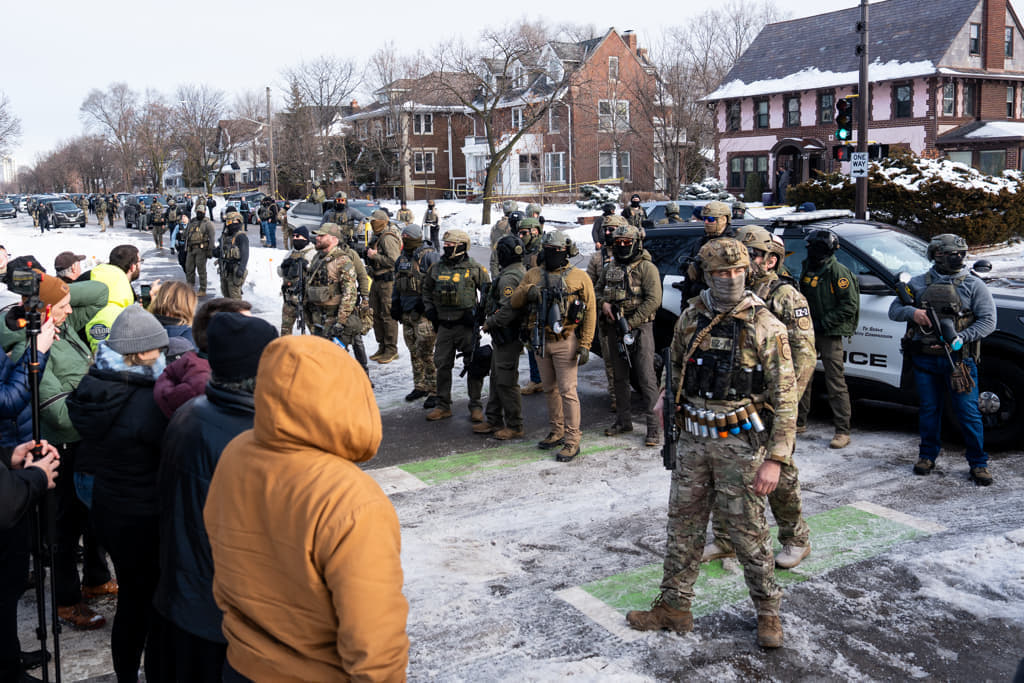
The recent fatal shootings of two U.S. citizens—Renée Good on January 7, 2026, and Alex Pretti on January 24, 2026—by federal immigration agents in Minneapolis have sparked intense debate over the use of force by ICE and Border Patrol amid President Trump's mass deportation efforts. Good, a 37-year-old mother, was shot three times at close range by ICE agent Jonathan Ross after an encounter during protests against ICE operations; video analysis shows her vehicle turning away from the officer when he fired. Pretti, also 37 and an ICU nurse, was shot multiple times (up to 10 shots in five seconds) by Border Patrol agents after intervening in a scuffle near a donut shop, with agents citing Pretti's licensed handgun—secured after he was pinned down and removed before he was shot—as justification for the killing. Both victims have been described as "domestic terrorists" by the Trump administration.
The state’s ultimate power is not merely its monopoly on violence, but its monopoly on the story told afterward. The killings of Good and Pretti crystallize a sinister modern ritual. The sequence is telling: lethal force is deployed, and then, with surgical precision, a narrative campaign is launched to justify the act. The deceased are not merely killed; they are posthumously reconstructed as moral threats, their deaths reframed as a public service—assassination, followed by character assassination. This process transcends simple cover-up or corruption. It represents a profound ethical corruption: the manufacture of moral righteousness to sanctify raw power. In this alchemy, violence is not hidden; it is purified, and the state rehearses its cruelty beneath a stolen halo of virtue.
This methodology—kill first, justify after—constitutes a distinct and grave ethical injury beyond the physical killing itself. It corrupts the foundational covenant between state and citizen, perverts public discourse, and systematically dismantles the moral capacity of the polity. By examining this process through the lenses of political philosophy, social theory, and media studies, we can trace how state violence, when coupled with narrative control, achieves a terrifying form of legitimacy. The result is not just a failure of justice, but a re-engineering of the public conscience to accept, and even demand, sacrificial logic.
I. The Pact Shattered: From Legitimate Violence to Narrative Sovereignty
Max Weber’s famous formulation—that the state is the human community that successfully claims the monopoly of the legitimate use of physical force—hinges on a fragile, reciprocal pact. Legitimacy is the keystone. The state may use violence, but only within constraints of law, proportionality, and, crucially, a publicly accessible rationale that appeals to shared moral reason. When a state agent kills, the burden of proof rests with the state to demonstrate that the action was necessary, just, and a last resort. The citizenry, in turn, grants its contingent consent based on this justificatory framework.
The ICE killings expose a rupture in this pact. Here, justification does not precede or intrinsically guide action but follows as a strategic public relations campaign. Legitimacy, which must be earned through transparent reason-giving, is replaced by a performative sovereignty of narrative. The state asserts not that it was right according to pre-existing norms, but that it can make the action right through the control of information and moral perception. This is raw authority masquerading as legitimacy, force cloaked in the language of ethics after the fact.
The ethical violation is twofold. First, there is the primal wrong of an unjustified killing. Second, and more insidiously, there is the wrong of sabotaging the very mechanism—public moral reasoning—by which a society would collectively judge that first wrong. The state, in this model, becomes both actor and judge, executioner and hagiographer. It does not seek forgiveness; it manufactures absolution.
II. The Double Death: Physical Elimination and Moral Annihilation
The process following such violence can be described as a double death. The first is the termination of biological life. The second, more prolonged and discursive, is the annihilation of the victim’s moral standing and human complexity. This “second death” is the essence of the justificatory machinery.
The script is drearily predictable: anonymous background leaks to media about “a known criminal past”; the selective release of mugshots or partial criminal records; insinuations of resistance or threat that cannot be independently verified because the primary witness is the state agent. The human being—with a history, relationships, fears, and potentials—is systematically erased. In their place arises a caricature: the “illegal alien,” the “gang affiliate,” the “threatening suspect.” This figure is an empty vessel, a symbol into which social anxieties—about borders, crime, cultural change—can be poured. As political theorist Judith Butler argues in Precarious Life, grievable life is life that fits within dominant frames of recognition. The narrative machine works precisely to render certain lives ungrievable, outside the circle of human concern whose loss would demand public mourning or outrage.
Once this symbolic transformation is complete, the ethical calculus is perversely inverted. The killing is no longer a tragedy to be explained; it becomes a virtuous act of cleansing, a removal of a contaminant from the social body. The public is invited not to pity the victim, but to thank the agent. This is where Hannah Arendt’s analysis of totalitarian logic becomes chillingly relevant. She observed the replacement of individual moral judgment with ideological reflex. The citizen does not stop to ask, “Was this right?” Instead, they feel, “If the state did it, it must have been necessary.” Sympathy atrophies. Critical thought is short-circuited by a prefabricated narrative of threat and heroism.
III. The Modern Scapegoat: Girardian Ritual in a Bureaucratic Age
The ancient practice of scapegoating, as analyzed by anthropologist René Girard, provides a powerful framework for understanding this dynamic. Girard posited that societies overcome internal crisis and mimetic rivalry by uniting against a arbitrarily chosen surrogate victim—the scapegoat. The sacrifice of this one person (or group) discharges collective tension and restores a fragile social peace, all while maintaining the fiction of the victim’s inherent guilt.
The ICE narrative machine is a bureaucratized, media-savvy incarnation of this archaic ritual. Society faces diffuse, intangible crises: economic precarity, globalized anxiety, perceived loss of sovereignty. The immigrant—particularly the undocumented one—becomes the perfect modern scapegoat. A killing by ICE, followed by its moral justification, performs a ritualistic function. It crystallizes abstract fears into a tangible enemy, offers a cathartic spectacle of state potency (“we are protecting you”), and reaffirms a boundary between “us” (law-abiding citizens) and “them” (the criminalized other). The victim’s death is transformed from a potential scandal into a foundational myth of order. The mechanism is camouflaged by the sterile language of “law enforcement” and “protocol,” but the sacrificial logic is unchanged.
IV. The Complicit Stage: Media and the Society of the Spectacle
This ritual requires a stage and a chorus. In the modern era, the media—particularly segments of it that operate on immediacy and sensationalism—often fulfills this role not as watchdog, but as amplifier. The theorist Guy Debord’s Society of the Spectacle is instructive here. We live, he argued, in a world where mediated images replace direct experience, where “all that once was directly lived has become mere representation.”
The spectacle of state justification exploits this condition. The messy, ambiguous reality of a human life ended violently is replaced by a curated set of images and data points: a flashing police light, a grainy still, a line on a criminal record. The media’s tools of framing (“ICE Kills Dangerous Fugitive”), sequencing (headline the allegation, bury the correction), and sourcing (relying on “official sources” without parallel investigation) actively participate in the second death. They provide the aesthetic and informational components that make the state’s narrative feel like reality itself.
This is not necessarily a conspiracy but a structural affinity. The state provides clean, dramatic, authoritative stories. The media, under pressure for clicks and clarity, often reproduces them uncritically. The result is what scholar W.J.T. Mitchell might call a “biopicture”: the reduction of a living being to a controlled image that serves power. The victim’s humanity is pixelated into oblivion.
V. The Foundational Lie: Dehumanization as a Precondition and Product
At the core of every apparatus of state violence lies the foundational lie of dehumanization. To kill without existential guilt, the killer—and the society that condones it—must first believe the target is not fully human. The ICE protocol exemplifies this. The rhetorical construction of “illegals” as a category preceding the shootings performs the essential preliminary work. It creates a perceptual frame in which individuals within that category are seen primarily as violations, as statuses, not as persons.
This is a direct assault on the cornerstone of modern ethical thought, most famously articulated by Immanuel Kant: the principle that persons must be treated as ends in themselves, never merely as means to an end. The posthumous justification process completes this Kantian violation. The victim is used twice over: first, as a means to enact a policy of deterrence or performative toughness; second, as a means to a narrative end—the restoration of a sense of order and moral clarity for the public. Their personhood is utterly instrumentalized.
The violence, therefore, is not an aberration within an otherwise moral system; it is the logical endpoint of a dehumanizing discourse. The narrative justification does not correct a wrong; it reinforces the very lie that made the wrong possible. It seeks to make the public complicit in the dehumanization, training us to see certain lives as less valuable, less real, less worthy of grief.
VI. The Cultural Metastasis: Ethical Numbness and the Death of Justice
When a society repeatedly engages in or acquiesces to this cycle of violence and narrative purification, the damage metastasizes from individual acts to cultural ethos. The result is a pervasive ethical numbness. The constant rationalization of cruelty erodes the moral vocabulary necessary to name it. Concepts like justice, dignity, and innocence become hollowed out, stripped of their universal application and weaponized as partisan slogans.
Killing shifts from being a profound, exceptional failure of the social contract to a normalized tool of governance. Public empathy, the muscle that flexes at the sight of unjust suffering, atrophies from disuse. It is replaced by moral fatigue—a cynical weariness that dismisses outrage as naïve performance. As philosopher Emmanuel Levinas warned, ethics begins in the face of the Other, in a fundamental responsibility provoked by their vulnerability. The justificatory machinery is designed precisely to prevent us from seeing that face, replacing it with a threatening mask.
In this atmosphere, active cruelty can thrive not because it is openly celebrated, but because the collective capacity to recognize and resist it has been systematically dismantled. Cynicism becomes the default posture, an anesthetic against moral pain. The public ceases to believe in the possibility of impartial justice, viewing every claim of wrongdoing through the lens of tribal allegiance. The state’s power becomes untethered from truth, anchored only in its ability to control the story.
VII. Toward Reconstruction: The Civic Labor of Truth and Empathy
Resisting this engineered corrosion of conscience demands intentional, collective labor. It requires the rehabilitation of two eroded civic virtues, which are in fact two sides of the same coin: truth and empathy.
Truth, in this context, is not passive reception of information but an active, disciplined practice. It demands a journalism reconceived as a forum for rigorous moral accountability, not a conduit for official statements. It requires journalists and citizens alike to treat every state justification as a claim, not a verdict. It insists on forensic curiosity: demanding full evidence, contextualizing facts, seeking out counter-narratives from families and communities, and relentlessly focusing on the chain of decisions that led to lethal force. This is the antithesis of the spectacle; it is the slow, difficult work of reconstruction.
Empathy is the complementary moral discipline. It is the conscious refusal of the dehumanizing frame. It is the insistence on remembering the victim as a person—a someone with a name, a history, a mother, a laugh, a flawed and complex humanity. This is not about sentimentality, but about justice. In Catholic social teaching and secular humanist thought alike, human dignity is inalienable and non-contingent; it is not a reward for good behavior but the foundation of any moral order. Empathy is the practical recognition of that dignity. It forces the uncomfortable questions: “What if this were my brother? What if the story being told about him were incomplete or malicious?”
This labor is profoundly counter-cultural. It goes against the grain of the spectacle’s speed and simplicity. It is often disparaged as “political” or “biased” precisely because it challenges official narratives. Yet, it is the essential work of democratic repair.
Conclusion: The Soul of a Civilization
The ethical crisis illuminated by the ICE killings is not an isolated policy failure. It is a diagnostic of a political culture flirting with moral autocracy. The state may temporarily maintain its borders or its sense of order through the sword, but a civilization can only maintain its soul through a commitment to truth and a recognition of shared humanity. When the state kills and then manipulates its citizens into believing it was good, it commits a violence that is both physical and spiritual. It attacks the ability of the body politic to know right from wrong.
Our complicity is not measured in our direct hand in violence, but in our consumption of and silence toward the justifying narratives. The greatest danger is not that we become a society that commits atrocities, but that we become a society that has talked itself into believing its atrocities are virtues. The fight, therefore, is not merely for policy reform or accountability in specific cases, though those are crucial. It is a fight for the very language of conscience—to reclaim the power to name a victim a victim, a wrong a wrong, and to remember that no halo fashioned from lies can ever sanctify the taking of a human life. The republic’s integrity depends not on the stories it tells after the blood is shed, but on the principles that prevent the shedding from being deemed just in the first place.