Trumpism and Zionism
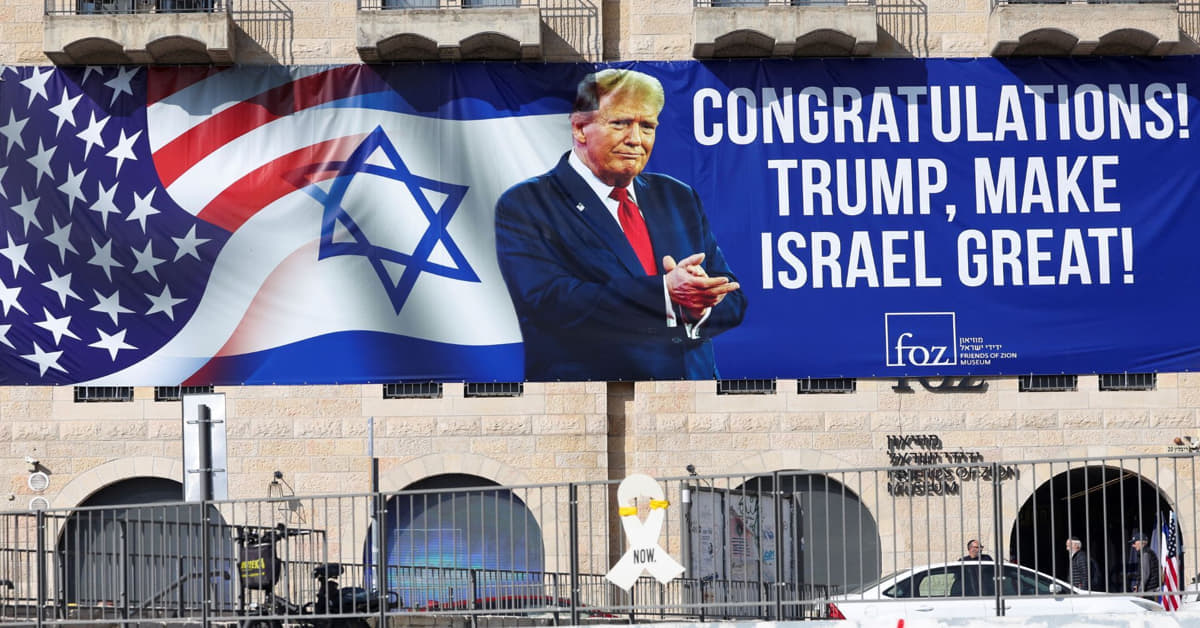
It is a given that President Trump strongly supports Israel; that was never in doubt. In his victory rally, for example, some of the freed Israeli hostages and their families were standing behind him on stage wearing yellow scarves (including Noa Argamani), and Trump expressed outrage that one hostage, not onstage (Emily Damari, a dual citizen, British and Israel) had two fingers shot off. Fair enough. But one could not, therefore, help but notice that there were no Palestinian hostages, released by Israel, onstage behind him. Of the total 90 Palestinian hostages released by Israel—21 are children. You see, only in Israel are children arrested for being “terrorists.” And then held without any charges; merely on suspicion (known as administrative detention). Israel holds 1200 such hostages. Nor did Trump express any kind of sympathy for the slaughter of thousands of children of Gaza—just for the fingers of Ms. Damani. Atrocity, it seems, flows just one way.
One could also not help but notice that the three hostages released on January 17, 2025 were in the pink of health, while the hostages released by Israel show that they have been through hell, and they describe enduring horrendous conditions: lack of food, overcrowding, beatings, torture, being pepper sprayed, and so on. You know, the usual methods employed on prisoners by civilized nations.
But for those supporting Trump, as per the visuals onstage, it is a given that you have to be outraged by Hamas, and you have to valorize Israel. That is the proper mode of behavior for being “conservative” and "civilized."
And this brings us to a crucial point—one of definitions, which now must be made in order to truly understand what is happening in the current Western political sphere, where Trumpism has seamlessly merged with Zionism (if ever there was any doubt about this in the past); and this includes the governments of Hungary, Italy, Argentina, and the one waiting in the wings in the UK (Nigel Farage)..
Trumpism is defined by the following:
It has an emphasis on sovereignty and national identity, both of which seek to protect American jobs and industries. And so, there is a call for strict immigration laws and the control of mass migration. It is a form of nationalism which tries to protect the American worker.
Then, there is a loose form of populism, which appeals to those who feel marginalized by elites in politics and business. It is here that anti-establishment rhetoric is often employed, in order to portray Trump as the champion for the "forgotten" working class, and against perceived elite interests. Never mind that Trump himself is precisely such an “elite.”
Thus, Trumpism promotes the revival of American manufacturing and industrial abilities; the argument being that economic policies need to bring tangible results, namely, job creation in traditional industries rather than free-market ideologies. This also means that the government needs to intervene in the economy in order to benefit the American worker.
Trumpism is also marked by pragmatism over ideology, so that in order to achieve practical goals, at times contradictory positions are adopted. For example, in the area of trade, there is both protectionism and the call for international market liberalization. Trump is all about tariffs, which he says will protect American jobs and manufacturing, while also calling for an open international market. Why should other markets open up when America is hedged in by tariffs? By trying to protect domestic industries via tariffs conflicts with current models of internationalized production, in which different stages of manufacturing happen in various countries.
As for culture, Trumpism has little to offer other than a broad rejection of political correctness or Wokeism, and giving voice to disgruntlement. Culture does not play a role at all in Trumpism.
In short, Trumpism capitalizes on economic discontent and a vague sort of nationalism, or patriotism; vague because both quickly fall by the way side when practical economic solutions are needed: unrestricted ca[italism contends with the nationalist, America First ideology, both of which contend with the corporrate requirements of the billionaire class, which was so perfectly lined up behind him at his nauguration.
This, then, brings an added challenge—how to achieve growth? Through tax cuts and deregulation? And by protectionist measures that will stop growth? For example, Trump wants to both reduce inflation and impose high tariffs on imports, which means that ordinary Americans will have to pay extra for goods that they bought cheaper before Trump’s protectionism.
How can there be any sort of coherent economic policy when Trump wants business growth, while reducing international engagement?
Currently, there is a hot debate about immigration, with mass deportation of undocumented workers. When that happens, how will the need for a robust workforce match up with strict immigration laws?
The United States has a severe shortage of skilled workers, especially in manufacturing and the healthcare and tech industries. Each day, 10,000 workers retire, while the younger Americans do not have the requisite education and training to take over these jobs. It is estimated that 75 percent of US employers cannot find workers. Sure, you can kick out all those labeled as "undesirable." Then what are you going to do? Starting a massive training and education program to fill demands of the workplace will require many years to bring about. What will industry and manufacturing and healthcare do in the meantime—just wait for native-born Americans to get educated and trained? Here, we see ideology trumping practicality.
Then, there are the ideological problems.
Trumpism brings together a diverse coalition that includes hardline nationalists, fiscal conservatives, and evangelical Christians. And these groups pursue different agendas, which leads to paradox. For example, Trump wants to cut taxes, but maintain social programs (Social Security). How he can do this is anyone’s guess.
Because of these many contradictions, Trumpism needs a common enemy, which is often identified as “the liberals,” or “the left,” and the “deep state.” It is through the hatred of these that Trumpism achieves a degree of unity. But is this any way to run a country?
Enter Zionism.
Zionism is a thoroughly nationalist, because it claims that Jews are a distinct nation who need a sovereign state. It advocates a racial, religious and cultural identity, which thrives by excluding the enemy (the indigenous Palestinians). Thus, nationalism is a “virtue,” as one Zionist apologist describes it. There is nothing not to like here for any thorough-going Trumpist.
Next, Zionism is a natural fit for the Evangelical Trumpists, since Zionists have long hijacked the Bible and have honed the technique of pandering to such religiosity by claiming to be “the people of God.” What true-blooded Evangelical is going to go against “the people of God?”
Next, Zionism is fully supported by big money (Jewish and non-Jewish), Since so much of Trumpism is about economics, Zionism will always come out the winner, since there is nothing that money cannot buy, as the saying goes.
Finally, Zionism promotes its own enemy for Trumpists to revile and hate—the Muslims, who are all relegated to being terrorists and barbarians. Zionists love to state that they represent “civilization,” and thus Israel stands alone against the “barbarian” hordes who are just waiting to burst in and destroy everything. After Israel, the deluge. Which always leads to expected outrage—because Trumpism assumes that it represents the highest degree of Western civilization. For Zionists, it is Islam which is the “deep state,” which the “leftards” love. And no honest Trumpist is going to approve anything loved by lefties.
In this way, the energy of Trumpism is readily coopted and consumed by Zionism. And so, it is hardly surprising that Trump's administration is the most pro-Israel in U.S. history, because Israel is held up as the ideal of nationalism and sovereignty.
Perhaps the better question to ask is how much of Trumpism will remain when Trump’s four-year term comes to an end? Politics needs a lot more than disgruntlement and outrage to endure. Or will it be just be easier to adopted everything Zionist? Which is never a stretch for Trumpism, since Zionism is the "glue" of Trumpism.