What is the West?
When people spoke of the West, they often understood this broad category to mean the history and culture of western Europe, and its political alignment with the United States. Thus, there was always talk of “shared values” which transcended geography, and thus even places like Japan, Hong Kong, Singapore, Australia and New Zealand were part of the West. These “shared values” were defined as “democracy,” the “rule of law,” “individual liberty,” and “secularism.”
The West further meant not only “civilization” but its excellence. And the process of such excellence came to mean “modernity,” or the triumph of the Enlightenment, by way of reason, science, individualism, secularism and technological progress.
A closer examination of the West told of a mindset that always sought to break from traditional and religious authority and move into rational thought and scientific understanding. Thus, the past was always a place of great darkness, filled with “superstition,” and hence “enlightenment” was the beginning of freedom, a condition seen as essential to the life of the West.
By overcoming “superstition,” the modern, western man was buoyed by endless optimism, fueled by individualism, which in turn was grounded in a new faith—that politics and technology would yield progress and the “good life” forever. A prominent place in this optimism was given to an expanding urbanization and capitalism, that is, an economic system characterized primarily by private ownership of the means of production for the purpose of generating profit, in which everyone could theoretically participate. This was also classified as the "American dream."
This then led to notions of increased social integration, through the movement of goods, people, capital, and information beyond local boundaries, accompanied by formal social organization and specialization of labor. This brought about liberalization, which was supposed to create freer markets and promote economic growth, by way of deregulation, privatization, and opening up to international trade and investment.
At the same time, the West meant a sensibility that embraced the new and the ephemeral, in order to emphasize the experience of the present moment, because modern life was a condition distinct from all previous forms of human social existence, in which a new social order was forever sought, and rapid change was highlighted, but always within the parameters of rationalization. However, this also ensured that the West was a place of social disruptions that nurtured alienation and disenchantment. Optimism and progress led to unexpected places.
Enlightenment and rationality also changed the West into a place of fractures, in which the purpose and meaning of life became contentious, and thus politics and money became salvific. Culture, the life of the mind, morality, and the inculcation of virtue were fragmented into lifestyle choices—decorations in the “real” drama of politics and money.
Historically, the notion of the West can be traced back to the Roman Empire, which eventually and geographically split into two—one in the Greek East (Byzantium) and one in the Latin West (which eventually became the Holy Roman Empire with Charlemagne). But it was the unity of the Roman world (both East and West, and even beyond into Africa, Central Asia and India) that was preserved by Christianity—what eventually became known as “Christendom,” that is, those in power, as rulers, promoted, protected and promulgated faith in Jesus as the Christ, within the body of Holy Mother Church. That was the meaning and purpose of western politics, so that the civilization, the culture, which emerged as a consequence of this faith eventually came to define both the eastern and western Roman worlds. In the East, of course, a Christiano-Judaic heresy would eventually come to dominate, now known as Islam.
The unity of the two portions of the Roman Empire endured in the East until 1453, after which that unity transitioned to Russia, which assumed the role and title of “the Third Rome,” and Islam came to dominate fully most of the east, with the Ottoman Turks. At the same time, in the West, unity came under focused assault from the Protestants (aligned with, and supported by, Islam), who very effectively destroyed Christendom, and in the process taught the West a new religion—revolution. This is the root of secularism in the West. And this is also the destruction of the very concept of homeland, which nationalism (right and left) would henceforth seek to establish by various means of domination (race or economics). With the destruction of Christendom, the West became rootless, and what remained of it became a fragment of what once was.
Henceforth, the true faith of the West would remain revolution, in which Christianity served only as a process (as with Oliver Cromwell and the Puritans, for example, who emigrated heavily to North America). The real purpose of life was the abrupt and fundamental overthrow of whatever that existed before and the ushering in of the new. And the only instrument of revolution is violence, both in word and deed. The revolutionary mindset always seeks to overthrow “tyranny”—and it is the privilege of the revolutionary to define what “tyranny” is to mean. This privilege is the basis of all power in western politics—the masses demand such a definition, because modern life acquires its true purpose and meaning by fomenting, or participating in, revolution. Therefore, violence is always righteous. The Protestants began by burning books, and then they burned witches. The West thus began to demand freedom for all, and then it bombed the innocent in far flung places for the sake of such freedom (and then it decries mass migrations, and launches into another revolution to oust the unwanted). Sic semper tyrannis. Thus, those who claim that the days of the West are numbered fail to notice the potency and attraction of revolution—for revolution makes the distinction between conservative and liberal entirely meaningless (since both are revolutionary) and it demands the necessity of violence. The cry for freedom is the first gear in the engine of slaughter. And the West long ago gave up being defined by geography.
Notice how the West now defines itself—as a democratic community of values. This is suitably highfalutin and meaningless, but a good revolutionary declamation like “Liberty, Fraternity, Equality.” But there can be no community or values without faith, as humans have long known; indeed, race may be a temporary replacement for faith, but it knows no longevity, since politics can never control who can couple with whom. And as for democracy, that has always been a vague concept ever since the Athenian experiment; for after Pericles, it has always been downhill into forms of absolutism. Revolutionary freedom demands its opposite—violence upon those labeled as the enemies of freedom.
So, to ask the famous question, what is to be done? The answer is an impossibility right now—the slow but steady growth of the Christian faith, Catholic and Apostolic, and not a Protestant “revival,” which is just another revolution. But the West will likely continue to believe in revolutions, for a very long time, all while yearning for an “identity,” which is yet another word for revolution. Only such a Catholic faith can regrow the true root of the West. Syncretism, whose political version is multiculturalism, has always failed historically; just ask the Manichaeans, or the followers of Theosophy, or the Baha’is. Humans cannot thrive with many roots, because truth is always One.
As long as the West runs after political saviors, it will ensure disasters for itself, by being an arena for endless social experiments. Revolutions cannot create; they can only destroy. This is a lesson that the West has yet to learn.
So, what is the West? It is the Prodigal Son, wasting its rich inheritance, wallowing away in the company of pigs. We cannot yet know when it will decide to come home.
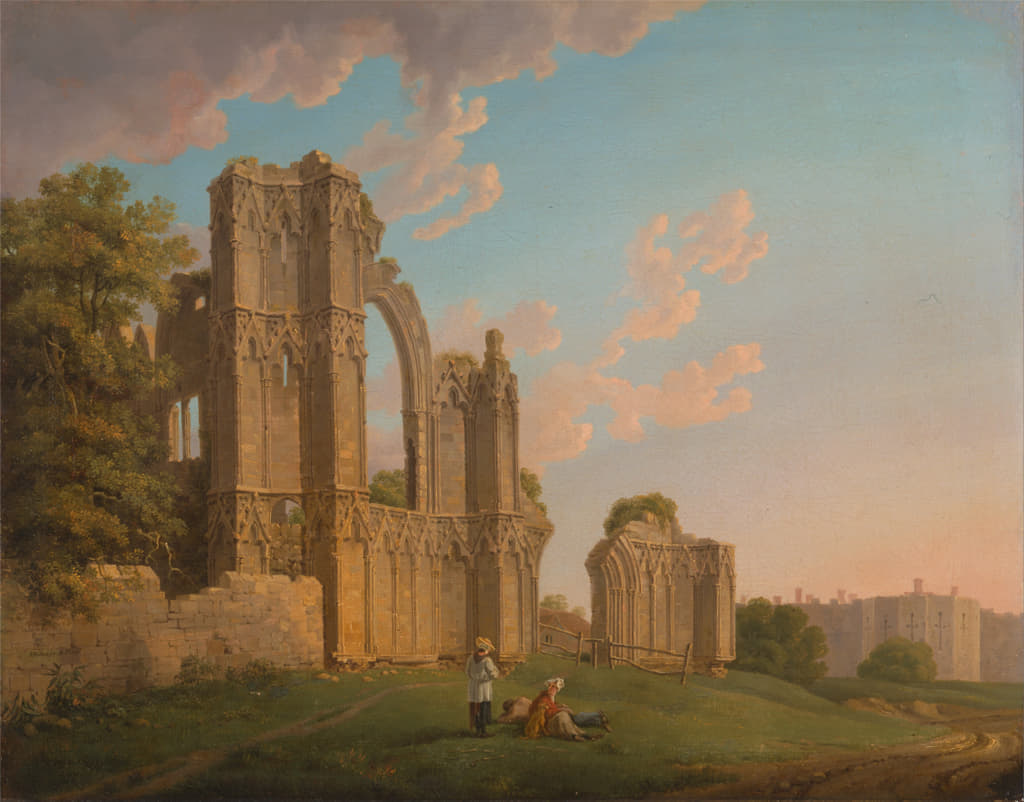
Featured: St. Mary's Abbey, York, by Michael Angelo Rooker (ca. 1778).