Why Do We Live In Two World?
“You see
them on the street. You watch them on TV. You might even vote for one this
fall. You think they’re people just like you. You’re wrong. Dead wrong.” — They Live
We’re living in two worlds, you and
I.
There’s the world we see (or are
made to see) and then there’s the one we sense (and occasionally catch a
glimpse of), the latter of which is a far cry from the propaganda-driven
reality manufactured by the government and its corporate sponsors, including
the media.
Indeed, what most Americans
perceive as life in America—privileged, progressive and free—is a far cry from
reality, where economic inequality is growing, real agendas and real power are
buried beneath layers of Orwellian doublespeak and corporate obfuscation, and
“freedom,” such that it is, is meted out in small, legalistic doses by
militarized police armed to the teeth.
All is not as it seems.
This is the premise of John Carpenter’s film They Live, which was released more
than 30 years ago, and remains unnervingly, chillingly appropriate for our
modern age.
Best known for his horror film Halloween, which assumes that there is a form
of evil so dark that it can’t be killed, Carpenter’s larger body of work is
infused with a strong anti-authoritarian, anti-establishment, laconic bent that
speaks to the filmmaker’s concerns about the unraveling of our society,
particularly our government.
Time and again, Carpenter portrays
the government working against its own citizens, a populace out of touch
with reality, technology run amok, and a future more horrific than
any horror film.
In Escape from
New York, Carpenter presents fascism as the future of America.
In The Thing,
a remake of the 1951 sci-fi classic of the same name, Carpenter presupposes
that increasingly we are all becoming dehumanized.
In Christine,
the film adaptation of Stephen King’s novel about a demon-possessed car,
technology exhibits a will and consciousness of its own and goes on a murderous
rampage.
In In the
Mouth of Madness, Carpenter notes that evil grows when people lose
“the ability to know the difference between reality and fantasy.”
And then there is Carpenter’s They Live, in which two migrant workers
discover that the world is not as it seems. In fact, the population is actually
being controlled and exploited by aliens working in partnership with an
oligarchic elite. All the while, the populace—blissfully unaware of the real
agenda at work in their lives—has been lulled into complacency, indoctrinated
into compliance, bombarded with media distractions, and hypnotized by
subliminal messages beamed out of television and various electronic devices,
billboards and the like.
It is only when homeless drifter
John Nada (played to the hilt by the late Roddy Piper)
discovers a pair of doctored sunglasses—Hoffman lenses—that Nada sees what lies
beneath the elite’s fabricated reality: control and bondage.
When viewed through the lens of
truth, the elite, who appear human until stripped of their disguises, are shown
to be monsters who have enslaved the citizenry in order to prey on them.
Likewise, billboards blare out
hidden, authoritative messages: a bikini-clad woman in one ad is
actually ordering viewers to “MARRY AND REPRODUCE.” Magazine racks scream
“CONSUME” and “OBEY.” A wad of dollar bills in a vendor’s hand proclaims, “THIS
IS YOUR GOD.”
When viewed through Nada’s Hoffman
lenses, some of the other hidden messages being drummed into the people’s
subconscious include: NO INDEPENDENT THOUGHT, CONFORM, SUBMIT, STAY ASLEEP,
BUY, WATCH TV, NO IMAGINATION, and DO NOT QUESTION AUTHORITY.
This indoctrination campaign
engineered by the elite in They Live is
painfully familiar to anyone who has studied the decline of American culture.
A citizenry that does not think for
themselves, obeys without question, is submissive, does not challenge
authority, does not think outside the box, and is content to sit back and be
entertained is a citizenry that can be easily controlled.
In this way, the subtle message of They Live provides an apt analogy of our
own distorted vision of life in the American police state, what philosopher
Slavoj Žižek refers to as dictatorship in democracy,
“the invisible order which sustains your apparent freedom.”
We’re being fed a series of
carefully contrived fictions that bear no resemblance to reality.
The powers-that-be want us to feel
threatened by forces beyond our control (terrorists, shooters, bombers).
They want us afraid and dependent
on the government and its militarized armies for our safety and well-being.
They want us distrustful of each
other, divided by our prejudices, and at each other’s throats.
Most of all, they want us to
continue to march in lockstep with their dictates.
Tune out the government’s attempts
to distract, divert and befuddle us and tune into what’s really going on in
this country, and you’ll run headlong into an unmistakable, unpalatable truth:
the moneyed elite who rule us view us as expendable resources to be used,
abused and discarded.
In fact, a study conducted by
Princeton and Northwestern University concluded that the U.S. government does not
represent the majority of American citizens. Instead, the study
found that the government is ruled by the rich and powerful, or the so-called
“economic elite.” Moreover, the researchers concluded that policies enacted by
this governmental elite nearly always favor special interests and lobbying groups.
In other words, we are being ruled by an oligarchy disguised
as a democracy, and arguably on our way towards fascism—a form of government
where private corporate interests rule, money calls the shots, and the people
are seen as mere subjects to be controlled.
Not only do you have to be rich—or
beholden to the rich—to get elected these days, but getting elected is also a
surefire way to get rich. As CBS News reports,
“Once in office, members of Congress enjoy access to connections and
information they can use to increase their wealth, in ways that are unparalleled
in the private sector. And once politicians leave office, their connections
allow them to profit even further.”
In denouncing this blatant
corruption of America’s political system, former president Jimmy Carter blasted
the process of getting elected—to the White House, governor’s mansion, Congress
or state legislatures—as “unlimited political
bribery… a subversion of our political system as a payoff to major
contributors, who want and expect, and sometimes get, favors for themselves
after the election is over.”
Rest assured that when and if
fascism finally takes hold in America, the basic forms of government will
remain: Fascism will appear to be friendly. The legislators will be in session.
There will be elections, and the news media will continue to cover the
entertainment and political trivia. Consent of the governed, however, will no
longer apply. Actual control will have finally passed to the oligarchic elite
controlling the government behind the scenes.
Sound familiar?
Clearly, we are now ruled by an
oligarchic elite of governmental and corporate interests.
We have moved into “corporatism” (favored by Benito
Mussolini), which is a halfway point on the road to full-blown
fascism.
Corporatism is where the few
moneyed interests—not elected by the citizenry—rule over the many. In this way,
it is not a democracy or a republican form of government, which is what the
American government was established to be. It is a top-down form of government
and one which has a terrifying history typified by the developments that
occurred in totalitarian regimes of the past: police states where everyone is
watched and spied on, rounded up for minor infractions by government agents,
placed under police control, and placed in detention (a.k.a. concentration)
camps.
For the final hammer of fascism to
fall, it will require the most crucial ingredient: the majority of the people
will have to agree that it’s not only expedient but necessary.
But why would a people agree to
such an oppressive regime?
The answer is the same in every
age: fear.
Fear is the method most often used
by politicians to increase the power of government. And, as most social
commentators recognize, an atmosphere of fear permeates modern America: fear of
terrorism, fear of the police, fear of our neighbors and so on.
The propaganda of fear has been
used quite effectively by those who want to gain control, and it is working on
the American populace.
Despite the fact that we are 17,600
times more likely to die from heart disease than from a terrorist attack;
11,000 times more likely to die from an airplane accident than from a terrorist
plot involving an airplane; 1,048 times more likely to die from a car accident
than a terrorist attack, and 8 times more likely to be
killed by a police officer than by a terrorist , we have handed
over control of our lives to government officials who treat us as a means to an
end—the source of money and power.
As the Bearded Man in They Live warns, “They are dismantling the
sleeping middle class. More and more people are becoming poor. We are their
cattle. We are being bred for slavery.”
In this regard, we’re not so
different from the oppressed citizens in They Live.
From the moment we are born until
we die, we are indoctrinated into believing that those who rule us do it for
our own good. The truth is far different.
Despite the truth staring us in the
face, we have allowed ourselves to become fearful, controlled, pacified
zombies.
We live in a perpetual state of
denial, insulated from the painful reality of the American police state by
wall-to-wall entertainment news and screen devices.
Most everyone keeps their heads
down these days while staring zombie-like into an electronic screen, even when
they’re crossing the street. Families sit in restaurants with their heads down,
separated by their screen devices and unaware of what’s going on around them.
Young people especially seem dominated by the devices they hold in their hands,
oblivious to the fact that they can simply push a button, turn the thing off
and walk away.
Indeed, there is no larger group
activity than that connected with those who watch screens—that is, television,
lap tops, personal computers, cell phones and so on. In fact, a Nielsen study
reports that American screen viewing is at an all-time high. For example, the average American watches
approximately 151 hours of television per month.
The question, of course, is what
effect does such screen consumption have on one’s mind?
Psychologically it is similar to drug addiction.
Researchers found that “almost immediately after turning on the TV, subjects reported feeling
more relaxed, and because this occurs so quickly and the tension
returns so rapidly after the TV is turned off, people are conditioned to
associate TV viewing with a lack of tension.” Research also shows that
regardless of the programming, viewers’ brain waves slow down, thus
transforming them into a more passive, nonresistant state.
Historically, television has been
used by those in authority to quiet discontent and pacify disruptive people.
“Faced with severe overcrowding and limited budgets for rehabilitation and
counseling, more and more prison
officials are using TV to keep inmates quiet,” according to Newsweek.
Given that the majority of what
Americans watch on television is provided through channels controlled by six
mega corporations, what we watch is now controlled by a corporate
elite and, if that elite needs to foster a particular viewpoint or pacify its
viewers, it can do so on a large scale.
If we’re watching, we’re not doing.
The powers-that-be understand this.
As television journalist Edward R. Murrow warned in a 1958 speech:
fat, comfortable and complacent. We have currently a built-in
allergy to unpleasant or disturbing information. Our mass media reflect this.
But unless we get up off our fat surpluses and recognize that television in the
main is being used to distract, delude, amuse, and insulate us, then television
and those who finance it, those who look at it, and those who work at it, may
see a totally different picture too late.
This brings me back to They Live, in which the real zombies are not
the aliens calling the shots but the populace who are content to remain
controlled.
When all is said and done, the
world of They Live is not so
different from our own. As one of the characters points out, “The poor and the
underclass are growing. Racial justice and human rights are nonexistent. They
have created a repressive society and we are their unwitting accomplices. Their
intention to rule rests with the annihilation of consciousness. We have been
lulled into a trance. They have made us indifferent to ourselves, to others. We
are focused only on our own gain.”
We, too, are focused only on our
own pleasures, prejudices and gains. Our poor and underclasses are also
growing. Racial injustice is growing. Human rights is nearly nonexistent. We
too have been lulled into a trance, indifferent to others.
Oblivious to what lies ahead, we’ve
been manipulated into believing that if we continue to consume, obey, and have
faith, things will work out. But that’s never been true of emerging regimes.
And by the time we feel the hammer coming down upon us, it will be too late.
So where does that leave us?
The characters who populate
Carpenter’s films provide some insight.
Underneath their machismo, they
still believe in the ideals of liberty and equal opportunity. Their beliefs
place them in constant opposition with the law and the establishment, but they
are nonetheless freedom fighters.
When, for example, John Nada
destroys the alien hyno-transmitter in They Live,
he restores hope by delivering America a wake-up call for freedom.
That’s the key right there: we need
to wake up.
Stop allowing yourselves to be
easily distracted by pointless political spectacles and pay attention to what’s
really going on in the country.
The real battle for control of this
nation is not being waged between Republicans and Democrats in the ballot box.
As I make clear in my book Battlefield America: The War on the American People, the real battle for control of this nation is taking place on roadsides, in police cars, on witness stands, over phone lines, in government offices, in corporate offices, in public school hallways and classrooms, in parks and city council meetings, and in towns and cities across this country.
The real battle between freedom and
tyranny is taking place right in front of our eyes, if we would only open them.
All the trappings of the American
police state are now in plain sight.
Wake up, America.
If they live (the tyrants, the oppressors, the invaders, the overlords), it is only because “we the people” sleep.
Constitutional attorney and author John W. Whitehead is founder and president of The Rutherford Institute. His new book is Battlefield America: The War on the American People.
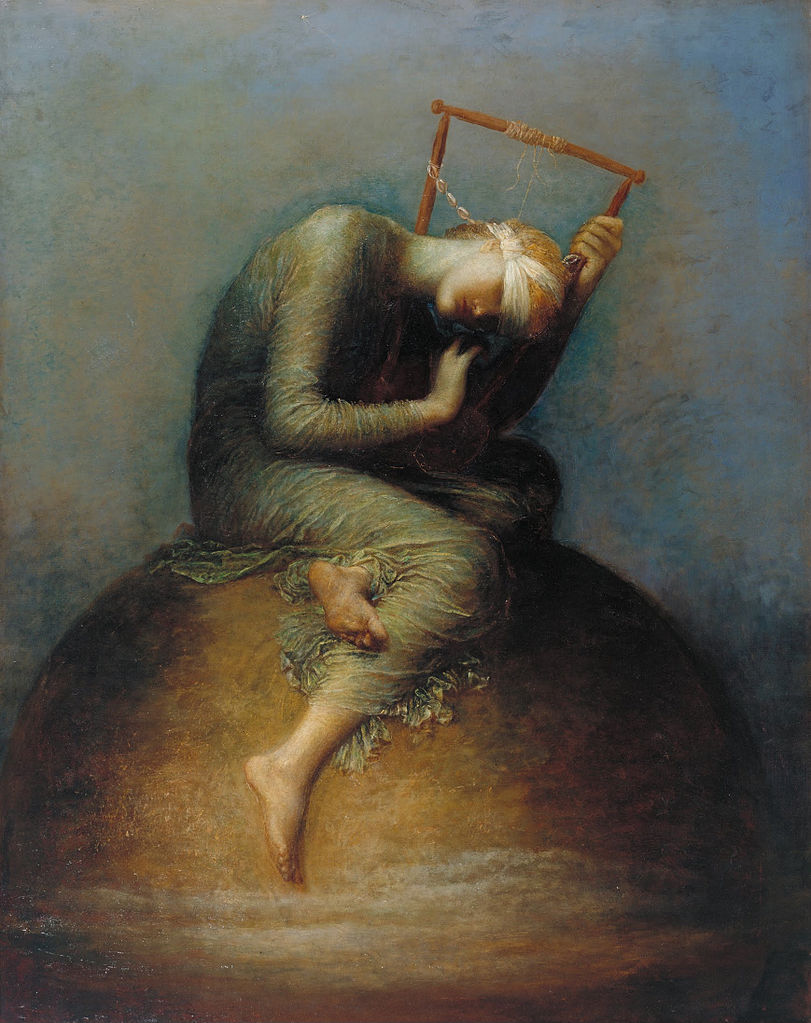
The photo shows, "Hope" by George Frederic Watts, painted in 1886.