Why Pachamama?
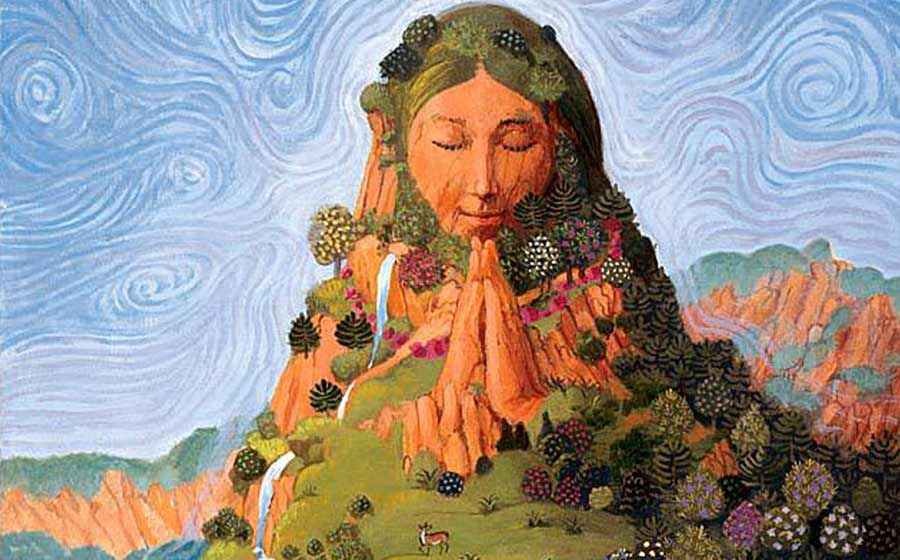
The recent Amazon Synod has been a source of controversy, to say the least; but the most curious event was the introduction of an Andean mother goddess, named, Pachamama, into Christian holy space. This raises some crucial issues.
But, first, who exactly is “Pachamama?” The name is a hybrid
(indigenous Aymaran
and Spanish) and is used by Quechua-speakers.
The meaning of “mama” is obvious; pacha means “earth,” “world,” “time,”
“season,” “harvest,” and “spring.” Therefore, literally translated, “Pachamama”
is “Earth-mama,” “Harvest-mama,” or “Spring-mama.” As such, she is perhaps a pre-Christian
Andean goddess of fertility, who lived in the soil and assured nature’s
cooperation with humans. She is paired with “Pachatata,” or “Earth-father” (note
again the hybridism). There are twin temples to both on Amantani island (mentioned
by the chronicler, Martin de Murúa).
Given this goddess’s ceremonious entry into St.
Peter’s Basilica, there is the easy assumption that she somehow represents the
Virgin Mary. This casual syncretism is a false understanding of the Andean
context, a habit of mind nurtured by people like Joseph Campbell and his cicerone, James G.
Frazer, of The Golden Bough fame. The
claims of persistent mythic “archetypes,” somehow ingrained in the human
“psyche,” are baseless, as neither linguistics or history support them. But such
arguments have great appeal, because they fashion intrigue, and therefore become
“settled history.” For example, Catholicism is still said by many to be a pagan
cult foisted upon the world, in which the Virgin Mary is a “refurbished” mother
goddess (this stems from Alexander Hislop, who in 1856 published his fantasy bestseller,
The Two Babylons). Society at
large has always suffered from severe historical amnesia.
Syncretism is also supposedly “proven” by the fact
that Quechua uses the term, wir’xena/wirhina, when referring to Pachamama,
in that the word connotes a “lady” and is derived from the Spanish, virgen
(virgin).
But equating wir’xena to the Blessed Virgin is
a mistake, because Quechua-speakers do not make this connection. Wir’xena
only refers to Pachamama, and Mary is only invoked by the term, Virgen.
Linguistically there is never any confusion, no matter the origin of these
specific words. Thus, language clearly demarcates the Christian from the
cultic. Of course, none of this is news to anyone in the know.
So, why the parading of Pachamama inside St. Peter’s?
There are two interconnected ideologies that currently preoccupy the West –
progressivism and repaganization.
Pachamama embodies both.
Progressivism seeks human liberation through social
means; and one such means is repaganization, or the recouping of hearts, minds
and territory from the imagined destruction wrought by Christianity, the WMD of
colonialism. In what now also passes as “settled history” – Christian, European
colonialists subdued wise, gentle, peace-loving natives the world over and
deployed Christianity to use and abuse them.
To counter this cultural “vandalism,” repaganization employs
two strategies: environmentalism and indigeneity. Environmentalism is little
concerned with pollution as such, but with bringing about eco-socialism, that
is, a new world, a heaven on earth, in which all life-forms will live in
blissful harmony (aka, the New Green Deal). The first step in achieving this “salvation”
is the toppling of all old systems (“norm criticism”), chief among them being
colonialism and its side-kick, Christianity.
The first method for carrying out all this overturning
is indigeneity, that is, privileged, racial groups, artificially created by NGOs.
All this became entrenched by 2004, when the UN-funded Decade for Indigenous
Peoples ended. Hereafter, the world was to be reconfigured and thus “saved” by
“ancient,” “environmental,” “indigenous” “wisdom.” Many an ardent PhD and
researcher is out and about “uncovering”
(i.e., creating) this “rich,” “lost” sapience.
Through indigeneity, progressivism has also coopted Christianity
and made into one more effective NGO, which will happily carry out the “work”
that is “relevant” to bringing about a “just” society (i.e., the various
demands of progressivism). Protestants signed on early. Some Catholics and the
Orthodox remain the holdovers.
This is where indigenization again comes in handy, in
the form of archaeofuturism, wherein the ancient
gods of Europe are to be revived, in order to bring back “native European”
wisdom destroyed by Christianity. And there is also Kemeticism, which advocates the gods of
ancient Egypt as “authentic” to people of African descent. And for those who do
not want to commit to any specific god or goddess just yet, there is the magic and shamanism of the grimoires. Many a
church building, therefore, stands empty and emptying, losing its flock not
only to atheism and acedia, but also to “spirituality.”
This neo-paganism is slickly packaged as
environmentalism for broader and greater appeal, especially among the Christian
holdovers.
The end-game of all this toppling is eco-socialism, wherein
nature possesses the legal rights of a mother, and humans owe legal obligations
to their geo-matriarch; and all of it enforced by the state: “The ‘Rights of Mother Earth’ is a call to leave
the dominant anthropocentric paradigm and to imagine a new Earth society.”
In this system, a repaganized humanity is the perfect citizenry, for the earth
can only belong to itself. It cannot be possessed by human beings, which thus
requires the need to “overcome,
redefine and limit the concept of property.” Humanity can no longer belong
to itself.
The nightmare continues. “…Pachamama,
or Mother Earth, is a being that embraces the living world,” in which the
purpose of life will be to “create Earth
governance systems at all levels – an Earth democracy that takes into account
not only humans but also nature.” And here the true face of eco-socialism
stands revealed: “Pachamama
is the mother that nurses her children; if this mother that nurses is not
poisoned, is not looted, is not contaminated, it is possible that, really,
there is a socialism.” This planet-wide “earth society” will be a grim non-anthropocentric
one, governed by “earth Jurisprudence,” where human life will no longer have
privileged status. A mosquito and a man will have equal value.
It is this “eco-society” that is embodied by
Pachamama, where a sacralized life of the planet will be guaranteed by the elimination
of any and all potential of humanity to bring harm to mother nature. For the
Church, the issue therefore is no longer about syncretism, ecumenism, or even liberal
theology – all these were yesterday’s wars. The issue today is this – what will
the Church become in a non-anthropogenic world? Agreeing to environmentalism is
agreeing to such a world. Perhaps the Amazon Synod is a glimpse into that new “Church,”
governed by the jurisprudence of Pachamama.
Near the end of His ministry upon the earth, our Lord asked a very sad question which takes on great urgency today: “But when the Son of Man comes, will he find any faith on the earth” (Luke 18:8)?
The photo shows the goddess Pachamama.