Saint Mary's Church of Tabriz, Iran: Ancient and Modern Sanctuary
Introduction
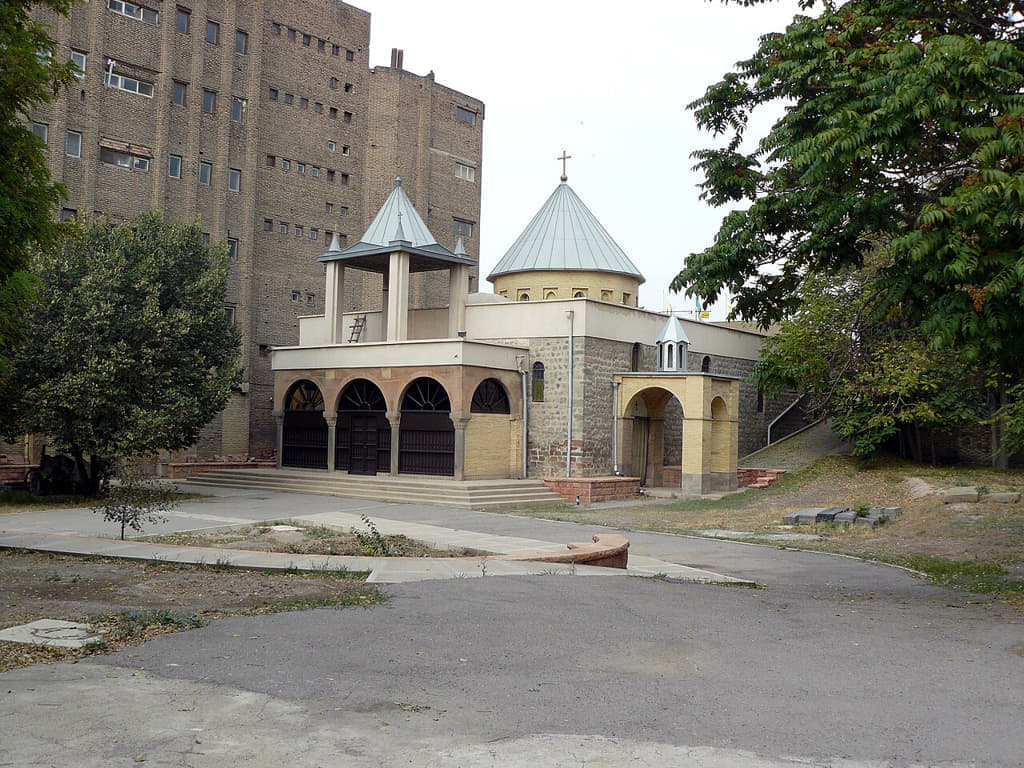
In the heart of Tabriz, at the corner of what are now North Shariati and Jomhuri avenues in the historic Dik Bashi neighborhood, stands Saint Mary's Church—the oldest and largest Christian church in one of Iran's most significant historical cities. Known formally as Surp Mariam Asdvadzadzin (Holy Mother of God Church), this Armenian Apostolic sanctuary represents more than merely a place of worship; it embodies the continuous presence of Armenian Christianity in Iranian Azerbaijan for nearly a millennium. Its stones bear witness to earthquakes that leveled cities, to the passage of merchants along the Silk Road, to the resilience of a community that survived invasion and displacement, and to the enduring architectural traditions that connected Armenian Tabriz to a broader Christian world. This history traces the church's journey from its legendary foundation in the twelfth century through its reconstruction in the eighteenth century to its role today as the spiritual heart of Tabriz's Armenian community.
The Origins: A Church on the Silk Road
The precise date of Saint Mary's foundation remains shrouded in the mists of medieval history, but scholarly consensus, drawing upon architectural analysis and historical references, places its establishment in the twelfth century AD—the sixth century of the Islamic calendar . This was a period when Tabriz was emerging as a major commercial and political center under the Seljuk Turks, who ruled much of Persia and Mesopotamia. The city's location along the Silk Road made it a meeting point for merchants, travelers, and religious communities from across Asia and Europe.
The most celebrated reference to this early church comes from Marco Polo, the Venetian merchant whose travels through Asia between 1271 and 1295 opened European eyes to the wonders of the East. Passing through Tabriz around 1275, Polo reportedly noted the presence of a church dedicated to the Virgin Mary . While Polo's account must be approached with caution—his original manuscripts no longer survive, and later copies contain interpolations—the reference aligns with what scholars understand of Tabriz's religious landscape in the late thirteenth century. Under the Ilkhanid Mongols, who had conquered Persia and converted to Islam, Tabriz became a capital city and a cosmopolitan center where Christians, Muslims, Jews, and Buddhists coexisted, often with remarkable tolerance.
The Mongol period proved particularly significant for Armenian Christianity. The Ilkhans, engaged in diplomatic maneuvering with the Mamluk sultans of Egypt and the Christian powers of Europe, at times cultivated relationships with Armenian rulers and clergy. The presence of an established Armenian church in Tabriz during this era reflects the community's importance in international trade and diplomacy. The oldest surviving architectural elements of Saint Mary's—particularly a stone hinge that, according to experts, displays decorative and structural features characteristic of thirteenth-century Ilkhanid construction—may date from this prosperous period .
Architecture and Community in the Medieval Period
The original medieval church, while vastly different from the structure visible today, established patterns that would persist through centuries of rebuilding. Armenian church architecture, with its distinctive combination of Eastern and Western influences, developed from the fourth century onward as Armenia became the first nation to adopt Christianity as its state religion. By the medieval period, a recognizably Armenian architectural vocabulary had emerged: centrally planned domed structures, conically roofed bell towers, and careful integration of stone construction with symbolic geometry.
The choice of location for Saint Mary's was no accident. The Dik Bashi neighborhood, where the church stood (and still stands), represented the heart of Tabriz's Armenian quarter. This proximity allowed the church to serve not merely as a liturgical space but as the focal point of communal life. Surrounding the sanctuary developed a complex of ancillary buildings—a prelacy, residential quarters for clergy, schools, and later a museum—that made the church compound a self-contained world for Tabriz's Armenian population .
The oldest surviving gravestone in the church cemetery dates to the sixteenth century, suggesting that the medieval structure, despite vicissitudes, continued to serve the community through the Safavid rise to power . The Safavid period, beginning in 1501, brought Shi'a Islam as the state religion of Iran, but the early Safavids, engaged in prolonged conflict with the Ottoman Empire, often treated their Armenian subjects pragmatically. Tabriz, as a frontier city repeatedly contested between Safavids and Ottomans, experienced numerous upheavals, yet the Armenian community—valued for its commercial connections and skills—persisted.
Catastrophe and Renewal: The Earthquake of 1780
The eighteenth century brought disaster to Tabriz and its ancient church. On what surviving records describe as a devastating day in 1780, a catastrophic earthquake struck the city, reducing much of its fabric to rubble. The medieval Saint Mary's Church, which had stood for approximately six centuries, collapsed in the trembling earth .
Earthquakes had long been a fact of life in Tabriz, situated in a seismically active zone, but the 1780 event proved particularly destructive. Contemporary accounts describe a city transformed into a graveyard, with thousands dead and virtually every significant building damaged or destroyed. For the Armenian community, the loss of their mother church represented both a spiritual wound and a practical crisis. Without a functioning sanctuary, the liturgical life that structured Armenian Christian existence—the daily offices, the weekly Divine Liturgy, the great feasts of Christmas, Easter, and the Assumption—could not proceed properly.
Yet out of this catastrophe emerged determination. Within two years of the earthquake, the Armenian community of Tabriz, under the leadership of their clergy and with the support of wealthy merchants, commenced reconstruction . The new church, completed in 1785, rose on the foundations of the old, incorporating surviving elements where possible but largely representing a fresh start. The inscription commemorating this rebuilding, still visible to visitors, testifies to the community's resilience and their devotion to the Mother of God to whom the church was dedicated .
The Architecture of the Rebuilt Church
The church completed in 1785, while preserving the sacred site, differed in significant ways from its medieval predecessor. The architects and builders of the late eighteenth century worked within architectural traditions that blended Armenian ecclesiastical forms with elements of Safavid Persian style—a synthesis characteristic of Armenian churches built in Iran during this period .
The resulting structure measures approximately sixteen meters in length by fourteen meters in width, a compact but dignified space oriented toward the east, where the sanctuary and altar stand . The walls, constructed of stone and brick, rise to support a vaulted ceiling, while the pillars that articulate the interior space combine stone bases with brick upper sections—a practical response to available materials that also creates visual interest through the contrast of textures and colors.
Most striking is the centrally positioned belfry, which rests upon four square columns. Between these columns, four arches support the tower above, and the spaces between the arches contain biblical paintings that instruct and inspire the faithful . This arrangement—a bell tower rising from the center of the church rather than from a separate campanile or a western facade—reflects Armenian architectural traditions while creating a distinctive internal space where the congregation, gathered beneath the tower, experiences a vertical axis connecting earth to heaven.
The tabernacle, or sanctuary area, preserves elements that architectural historians date to the twelfth-century church, carefully integrated into the eighteenth-century reconstruction . This continuity—ancient stonework incorporated into newer construction—symbolizes the church's role as a living link between generations of Armenian Christians in Tabriz. The faithful who pray before the altar stand in the same sacred space where their ancestors stood centuries earlier, their prayers joining an unbroken chain of supplication and thanksgiving reaching back to the medieval church Marco Polo may have visited.
The Church as Armenian Institutional Center
From its reconstruction in 1785 through the twentieth century, Saint Mary's served as more than a place of worship—it functioned as the institutional heart of Armenian Tabriz. For many years, the church compound housed the seat of the Azerbaijan Armenian archbishop, making it the administrative center for Armenian ecclesiastical affairs throughout northwestern Iran . This episcopal presence elevated the church's importance, drawing clergy, pilgrims, and petitioners from Armenian communities across the region.
The governance of the church reflected traditional Armenian practice, with a board of Armenian peers—respected laymen from the community—sharing responsibility with the clergy for the church's maintenance and operation . This board system ensured that the church remained connected to the community it served, its leadership drawn from among the merchants, professionals, and artisans who constituted Tabriz's Armenian population.
The church compound gradually expanded to include facilities supporting the community's needs. Educational institutions operated under church auspices, teaching Armenian language, history, and religion alongside secular subjects. The presence of a functioning Armenian school ensured cultural survival, transmitting language and identity to generations born in Iran but connected through the church to their ancestral homeland and traditions.
The Armenian Museum of Tabriz
Adjacent to the church, and operated by the Armenian Prelacy of Tabriz, stands the Armenian Museum—a more recent addition that reflects the community's commitment to preserving and presenting its heritage . The museum houses artifacts documenting Armenian life in Tabriz and Azerbaijan: liturgical objects, manuscripts, textiles, photographs, and everyday items that together tell the story of a community's centuries-long presence in the region.
The museum's establishment represents a modern phase in the church's evolution. As the twentieth century progressed and the Armenian population of Tabriz, like that of many Iranian cities, diminished through emigration to Tehran and abroad, the impulse to preserve material culture intensified. The museum ensures that even if the community grows smaller, its history will not be forgotten. For visitors—Armenian and non-Armenian alike—the museum provides context for understanding the church not as an isolated monument but as the center of a living community with a rich and complex history.
The Church in the Twentieth Century
The twentieth century brought profound changes to Iran and to its Armenian communities. The Constitutional Revolution of 1905-1911, the rise of the Pahlavi dynasty in 1925, the Second World War and Allied occupation of Iran, the 1979 Islamic Revolution—each of these watershed events affected Tabriz's Armenians and their relationship to their mother church.
Under the Pahlavi monarchs, who emphasized Iran's pre-Islamic heritage and promoted a narrative of national unity, Armenian Christians enjoyed citizenship rights and cultural freedoms, though always within the framework of an officially Muslim state. The church continued to function openly, its bells calling the faithful to prayer, its schools teaching Armenian children, its clergy celebrating the ancient liturgy unchanged through centuries of political transformation.
The 1979 Revolution and establishment of the Islamic Republic created new circumstances for religious minorities. The Constitution recognized Armenian Christians as a protected religious minority, entitled to practice their faith and maintain their cultural institutions. Saint Mary's continued to function, its congregation diminished but faithful, its fabric maintained by a community determined to preserve its heritage.
The Iran-Iraq War (1980-1988) brought new challenges. Tabriz, while not on the front lines, experienced the war's economic and psychological effects. Armenian young men, like their Muslim compatriots, were conscripted into military service, and some gave their lives for a country where they remained a small minority. The church prayed for peace and for the safety of its sons.
The Church in the Twenty-First Century
Today, Saint Mary's Church remains the largest and most important church in Tabriz, a functioning sanctuary where the Divine Liturgy is celebrated each Sunday and on feast days throughout the liturgical year . The congregation, smaller than in centuries past, nonetheless maintains the traditions inherited from their ancestors. Christmas, Easter, and the feast of the Assumption of the Virgin (for whom the church is named) draw the community together in prayer and celebration.
The church also serves as a pilgrimage destination for Armenians from elsewhere in Iran and from the diaspora. Visitors to Tabriz seeking their family roots or simply wishing to connect with Armenian heritage find at Saint Mary's a tangible link to the past. The church's ancient stones, its venerable icons, its cemetery with gravestones dating back centuries—these material witnesses to history speak to visitors in ways that written records alone cannot.
Conclusion
The history of Saint Mary's Church of Tabriz is, in microcosm, the history of Armenian Christianity in Iran: ancient foundations, periods of prosperity and cultural flowering, catastrophic destruction followed by determined rebuilding, adaptation to changing political circumstances, and persistence into the present. For nearly a thousand years, this sacred site has witnessed the prayers of generations, the birth and death of countless Armenians, the rise and fall of dynasties, the transformation of Tabriz from Silk Road entrepôt to modern industrial city.
The church that stands today, rebuilt in 1785 but incorporating elements far older, embodies the resilience that has characterized Armenian Christianity throughout its long history. Its walls have absorbed the vibrations of earthquakes and the echoes of liturgies; its bells have marked the hours and called the faithful to prayer; its doors have opened to welcome generations seeking the comfort of ancient rites and the community of fellow believers.
Saint Mary's stands as a testament to faith persisting across centuries. It is at once an Armenian church, an Iranian monument, and a Christian sanctuary—a place where the particular history of one community opens onto universal themes of devotion, loss, survival, and hope. As long as its lamps burn before the altar and its congregation gathers to pray, the long history of Saint Mary's of Tabriz will continue.