The Master of Fauvel, Parisian Illuminator
Introduction
The Master of Fauvel (ca. 1314–1340) is one of the most prolific yet elusive figures in the history of French Gothic illumination. Active in Paris between approximately 1314 and 1340, this anonymous artist derives his conventional name from the celebrated Roman de Fauvel preserved at the Bibliothèque nationale de France (BnF, fr. 146), a manuscript that stands as both his foundational work and the point of departure for an extensive corpus of attributions. The problematic of this essay concerns the extent to which his œuvre—produced largely within a workshop context for Parisian booksellers—participated in the formation of a French court painting, navigating between Gothic tradition, political satire, and pictorial renewal. The argument proceeds through an examination of the artist's professional milieu, the Roman de Fauvel as a laboratory of engaged painting, the diversity of his patronage and manuscript genres, his position relative to Jean Pucelle and the Parisian artistic landscape, and finally the historiographical stakes of constructing a corpus without a name.
An Anonymous Master in the Paris of the Book
The name "Master of Fauvel" is a modern scholarly construction, not a documented identity. It derives from BnF, fr. 146, the manuscript containing Gervais du Bus's satirical Roman de Fauvel in the revised version of Raoul Chaillou de Pesstain. The BnF authority record notes that the artist has sometimes been identified with Geoffroy de Saint-Léger, a Parisian bookseller-stationer—the son of a sworn bookseller of the University of Paris—who died in 1333. This hypothesis rests on the repeated appearance of Saint-Léger's name in a Bible now at the Bibliothèque Sainte-Geneviève (ms. 22). François Avril advanced this identification, but it remains precisely that—a hypothesis, not a certainty. The methodological difficulty is compounded by the artist's long period of activity, spanning over twenty-five years, during which his style evolved and his workshop accommodated numerous collaborators. Alison Stones has isolated a distinct group of manuscripts attributed to an assistant she terms the "Sub-Fauvel Master," raising fundamental questions about the internal hierarchy of production and the boundaries between individual authorship and workshop output.
The Master of Fauvel operated within the dense commercial network of the Parisian book trade, centered around the rue Neuve-Notre-Dame. His associates included booksellers such as Geoffroy de Saint-Léger, Thomas de Maubeuge, and Richard de Montbaston. The distinction between the approximately twelve manuscripts attributed to the master's own hand and the more than eighty assigned to his workshop is crucial. This disparity invites us to speak not of a strictly individual œuvre but of a "workshop style"—a visual idiom developed by the master and executed with varying degrees of finesse by assistants and collaborators. Thomas de Maubeuge, for instance, supplied books to members of the royal family, including Mahaut d'Artois, Guillaume I of Hainaut, Jean de Normandy, and Charles IV himself, and several of these volumes were illuminated by the anonymous artist now known as the Master of Thomas de Maubeuge. The Parisian bookseller thus functioned as an intermediary between aristocratic patronage and the illuminating workshop, a figure whose commercial acumen shaped the visual culture of the court as surely as the artists themselves.
The Roman de Fauvel: Laboratory of an Engaged Painting
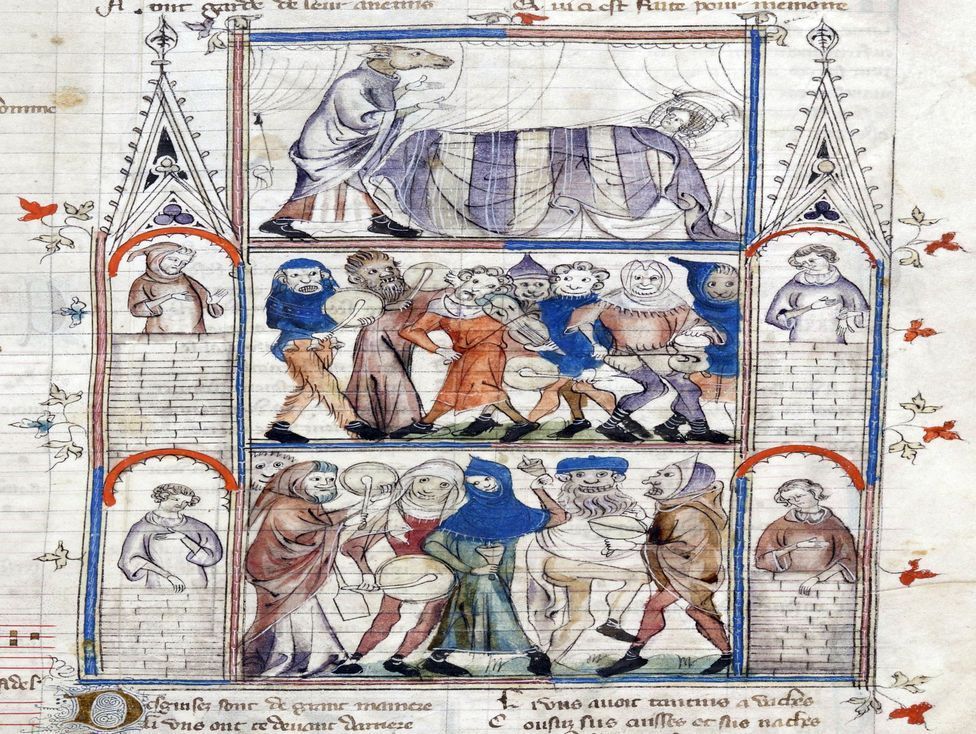
BnF, fr. 146 is a luxurious manuscript that combines French text, 169 notated musical pieces in Latin and the vernacular, and seventy-eight miniatures. This tripartite structure—text, music, and image—constitutes what may be described as a medieval Gesamtkunstwerk, a total work in which the three media cooperate to produce meaning. The revised version by Chaillou de Pesstain, dated to approximately 1316–1318, belongs to the final years of Philip the Fair's reign and the accession of Philip V. The satire targets corruption, avarice, and abuses of power, with a political dimension connected to Enguerran de Marigny. The manuscript addressed a lettered and curial public, one capable of decoding the allegorical veils beneath which the critique of the courtly world was concealed.
The miniatures function as a visual commentary on the text. The narrative sequence—the mounting of Fauvel, the submission of the powerful, Fortune's wheel, the marriage, the charivari, and the tournament—constitutes a sustained pictorial gloss. The hybrid figure of Fauvel himself, shifting between horse, centaur, and horse-headed man, resists stable interpretation and demands an active hermeneutic effort from the reader. This ambiguity is not decorative but structural: the reader cannot take the illustrations literally, and the resistance offered by the image compels an effort of elucidation, a movement between text and image that denounces Fauvel as a monstrous being and a source of the kingdom's misfortunes. The manuscript's layout, in which musical notation, text, and illumination share the page, creates an experience of reading that is simultaneously visual, literary, and auditory. The occasionally sketchy or satirical character of the images—what might appear as carelessness—should be understood as a pictorial mode capable of entertaining an elite while articulating a critique of the curial world. The Roman de Fauvel is thus not merely the manuscript that gave the master his name; it is the laboratory in which a form of engaged, politically charged illumination was tested and refined.
Painting for the Elite: Genres, Patrons, and Functions
The production attributed to the Master of Fauvel and his workshop encompasses a remarkable range of genres. Secular literature is represented by the Roman de Fauvel, the Roman d'Alexandre, and the Ovide moralisé; historical texts include the Grandes Chroniques de France of the 1330s; religious books comprise missals, breviaries, and a Petite Bible historiale (BnF, fr. 8); and documentary collections such as the Registre des actes de Philippe le Bel (Archives nationales, JJ 5) also received illumination. The Missel à l'usage de Paris (British Library, Harley 2891), produced in collaboration with Richard de Verdun around 1317–1318, exemplifies the workshop's engagement with liturgical manuscripts. This diversity reveals a clientele that was aristocratic and urban, but also institutional and administrative—milieux connected to royal power and its bureaucratic apparatus.
The Grandes Chroniques de France offer a particularly instructive case. In these manuscripts, illustration reinforces dynastic memory and monarchical ideology for a noble readership. The choices of iconography are inseparable from the social function of the book: to legitimize power, transmit the history of France, and affirm the status of the possessor. The question of the "court" thus arises with precision: did the Master of Fauvel work directly for the court, or did he produce objects adapted to the tastes and needs of elites close to power without being identical with it? The evidence suggests the latter. The booksellers who commissioned his work served royal and aristocratic clients, but the artist himself remained a workshop professional, responsive to demand rather than attached to a princely household. His images were designed to be legible, narrative, and adaptable to varied programs—qualities that made them eminently suitable for a market of elite consumers rather than for a single, unified courtly patron.
The Master of Fauvel and Parisian Painting of His Time
The comparison with Jean Pucelle is inevitable and illuminating. Pucelle, active in Paris during the 1320s and 1330s, represents the dominant figure of the generation that followed the Master of Fauvel, and his work is marked by a renewal influenced by Italian painting. Pucelle's refinement of spatial representation, his modeling of forms, and his interiorization of religious sentiment distinguish his approach from the more conservative current to which the Master of Fauvel belongs. The Master of Fauvel's style is characterized by narrative legibility, a vivid use of color, and architectural settings that serve the clarity of the story rather than the exploration of pictorial space. His figures are expressive and his compositions effective, but his concerns are those of a storyteller and moralist rather than a formal innovator.
Yet the opposition between "court" and "workshop" requires nuance. The Parisian booksellers, the illuminating workshops, and the aristocratic patrons formed a single cultural ecosystem. The Master of Fauvel's success owed less to radical formal innovation than to his capacity to supply clear, narrative images adapted to diverse programs. He represents another facet of French court painting: less aristocratic in manner than Pucelle, but essential to the visual diffusion of history, morality, and power. If Pucelle points toward the refined, Italianate tendencies that would culminate in the art of Jean de Berry's illuminators, the Master of Fauvel points toward the broad dissemination of a curial visual language, one capable of serving satire and monarchical glorification with equal facility.
Reception, Attribution, and Historiographical Stakes
The construction of a corpus without a name is an operation of stylistic inference. Art historians attribute manuscripts to the Master of Fauvel on the basis of style, motifs, associated booksellers, and comparison with BnF, fr. 146. The risks are considerable: confusion between master, assistants, and imitators; the evolution of style over more than twenty-five years; and the possibility that the "Sub-Fauvel Master" represents not a distinct personality but the same artist working in a less careful mode for less prestigious commissions. The Rouses' foundational work on commercial book producers in medieval Paris and Stones's isolation of the Sub-Fauvel group have refined the picture, but the fundamental uncertainty remains productive rather than paralyzing. It compels attention to the social and economic conditions of production rather than to the romantic notion of individual genius.
Recent research continues in the wake of François Avril's fundamental studies and the collective volume Fauvel Studies, edited by Margaret Bent and Andrew Wathey, which remains indispensable for understanding the manuscript's political, musical, and visual dimensions. The current interest in BnF, fr. 146 as a source for politics, music, the city of Paris, and courtly visual culture testifies to the manuscript's extraordinary richness. A final hypothesis may be formulated: the Master of Fauvel incarnates the normalization of a Parisian curial imagery, one capable of serving satire and monarchical glorification alike. His workshop produced the visual equipment of power and its critique with equal competence, a flexibility that reveals the interdependence of court and commerce in fourteenth-century Paris.
Conclusion
The Master of Fauvel is not merely the author of the images in a famous manuscript; he is the center of an important Parisian workshop active for a generation. His double importance lies in what he documents and what he reveals: the material culture of the courtly book and the diversity of pictorial languages in early fourteenth-century Paris. The question with which this essay opened—whether one can speak of a "court style" when the image is produced in series, by urban workshops, for patrons close to but not identical with royal power—admits no simple answer. Perhaps the very notion of a court style must be revised to accommodate the workshop as a mediating institution, one that translated aristocratic demand into visual form while maintaining its own commercial logic. The Master of Fauvel, anonymous and prolific, stands at the threshold of this transformation, his name a scholarly convenience and his œuvre a testament to the collective, commercial, and politically charged nature of Parisian illumination in the age of the last Capetians and the first Valois.