Trump's Shield of the Americas: Ideological Hubris and Geopolitical Delusion
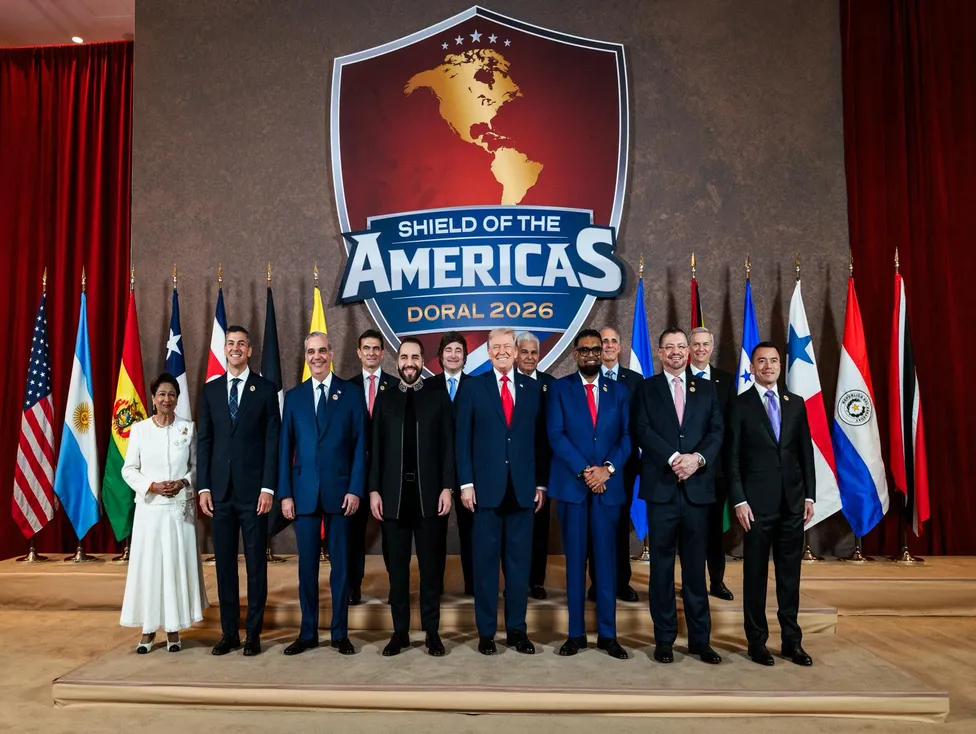
The inauguration of the "Shield of the Americas" security coalition on March 7, 2026, in Doral, Florida, marked a perilous turning point in hemispheric relations. Conceived by the Trump administration as an ideologically driven bloc focused on utilizing hard military force against Latin American drug cartels, the initiative—often referred to as the Americas Counter Cartel Coalition (A3C)—was sold to the American public as a decisive blow against transnational criminal organizations. However, a rigorous, systemic evaluation of the coalition’s framework reveals a deeply flawed, structurally unsound, and ultimately dangerous enterprise. Rather than securing the hemisphere, the Shield of the Americas is a geopolitical mirage. By excluding the region’s primary economic and geographic powers, ignoring the root socio-economic causes of crime, circumventing democratic oversight, and relying on a hollow, underfunded military posture, the initiative is structurally set up to fail. Far from dismantling cartels, it threatens to fracture regional multilateralism, trigger severe domestic constitutional crises, escalate violence, and permanently erode human rights and the rule of law across the Americas.
The Fatal Flaw of Exclusion: A Perimeter Without a Center
The most immediate and glaring structural deficiency of the Shield of the Americas is its highly partisan and arbitrary membership. The coalition completely excludes the region's major economies and the primary geographic hubs of the drug trade: Brazil, Mexico, Colombia, and Canada. This is not a minor diplomatic oversight; it is a fatal operational flaw.
Mexico, Brazil, and Colombia collectively represent more than half of the region's GDP and host the vast majority of Latin America's primary drug production and cartel hotspots. By leaving out Mexico and Colombia, the coalition completely bypasses the source countries of production and the primary transit corridors of the very cartels it claims to aim to fight. Furthermore, excluding Brazil—South America's largest economy and a crucial player in Amazonian security and cross-border trafficking—renders the coalition structurally incomplete.
The exclusion of these key regional powers is deeply rooted in the Trump administration's ideological alignment strategy. By systematically excluding the left-of-center governments of Mexico, Brazil, and Colombia, the alliance isolates itself from the exact territories where the primary transnational cartels operate. A security perimeter that does not include the geographic heart of the drug trade cannot, and will not, achieve its operational goals. As regional intelligence agencies have pointed out, it is operationally impossible to map, track, or disrupt the supply chains of sophisticated networks like the Sinaloa Cartel or the Jalisco New Generation Cartel (CJNG) when the countries hosting their leadership and principal infrastructure are excluded from the information network. The coalition has essentially formed a neighborhood watch that refuses to invite the neighbors who actually live on the block where the crime is happening.
The Illusion of "Hard Power": Ignoring the Roots, Inviting Abuses
Beyond its flawed geography, the Shield of the Americas is fundamentally misguided in its tactical approach. The initiative relies exclusively on hard, military-style crackdowns, demonstrating a profound neglect of the root causes of crime. Systemic poverty, weak state institutions, corruption, and lack of economic opportunity are the primary drivers that push vulnerable populations toward migration and cartel recruitment. The coalition ignores these underlying drivers entirely.
Moreover, the initiative fails to factor in environmental and agricultural disruptions—such as crop failures, droughts, and climate-exacerbated weather events. These environmental shocks routinely devastate rural economies and push desperate populations directly into the arms of illicit economies and cartel recruitment. By treating the cartels solely as a military problem, the coalition ignores the economic and environmental ecosystems in which they thrive.
This over-reliance on military force is not only ineffective; it is actively dangerous. Heavy-handed military deployments for domestic policing risk escalating human rights abuses, mass incarcerations, and executive overreaches. The coalition’s tactics invite emergency suspensions of protest rights, arbitrary detentions, and a complete erosion of judicial oversight. History has repeatedly shown that when militaries are deployed for domestic security and counter-cartel operations, the systematic result is the erosion of civil liberties. The future consequences of this approach include an increase in extrajudicial actions, mass arbitrary detentions, and a permanent damaging of the rule of law in participating states.
Furthermore, intelligence assessments clearly demonstrate that military-centric crackdowns—such as lethal maritime strikes and aggressive urban raids—have historically failed to reduce the volume or increase the street price of illicit goods reaching the United States. In countries like Ecuador, where the military has been deployed for domestic security, homicide rates have skyrocketed to historic highs. Rather than dismantling organized crime, these heavy-handed approaches cause cartels to adapt, fragment into smaller, more violent offshoots, and embed themselves deeper into local economies and vulnerable state institutions. It is a tactical failure that breeds more violence.
A "Paper Tiger" Framework: Underfunded and Vague
A critical examination of the coalition’s foundational documents reveals that the Shield of the Americas is functionally a "paper tiger." The four-point declaration that established the coalition lacks dedicated funding, concrete enforcement mechanisms, intelligence-sharing frameworks, and burden-sharing commitments. It is a political declaration masquerading as a functional treaty.
Without dedicated funding mechanisms, standardized intelligence-sharing protocols, or unified command structures, the alliance lacks the operational capacity to disrupt sophisticated, multi-billion-dollar criminal syndicates. Months after its inception, the coalition still operates without an approved, comprehensive operational plan or a unified strategic intelligence center. Instead of building interconnected regional databases to trace the cross-border trafficking of narcotics, illegal gold, timber, and weapons, the Shield relies on fragmented, top-down directives from U.S. agencies. This absence of a comprehensive data-sharing platform leaves states operationally isolated and unable to coordinate effectively.
The initiative also suffers from an ambiguous legal standing. In nations like Chile, participation has triggered severe domestic backlashes and constitutional debates over whether bypassing formal treaty ratification violates national sovereignty and traditional multilateral foreign policy. Because the Shield is structured as an ad hoc political framework rather than a formal, binding international treaty, it creates a dangerous gray zone in international law. It demands the operational compliance of member states without offering the legal protections or institutional stability of a ratified alliance. It is a structural blindspot that leaves participating nations vulnerable to U.S. unilateralism.
Economic Fallout: Trade Vulnerability and Forced Decoupling
The economic consequences of joining this coalition are profound and deeply troubling. The U.S. has leveraged the initiative to demand that member states back away from non-commercial or sovereign-adjacent agreements with their largest alternative trading partners. For nations whose economic survival relies heavily on mineral exports, agricultural trade, and massive infrastructure projects, this forced decoupling threatens vital streams of foreign direct investment (FDI).
Washington has demonstrated a chilling willingness to weaponize bilateral tools to enforce compliance. The February 2026 diplomatic crisis, where Washington revoked the visas of Chilean telecommunications officials for processing a submarine fiber-optic cable project, proved that participating in the Shield subjects regional policymakers to direct U.S. economic and administrative retaliation if they pursue independent development projects.
Rather than providing developmental economic aid to address the root causes of regional crime—such as systemic poverty—the initiative primarily introduces restrictions. Complying with U.S.-driven investment screening and supply chain regulations chokes off diverse capital flows without replacing them with new U.S. financial resources or trade concessions. The coalition demands that Latin American nations bear the economic cost of decoupling from global markets, yet it offers no economic lifeline in return. This aggravates domestic financial strain and breeds deep resentment among the very populations the coalition claims to protect.
Fragile Political Foundations and the Erosion of Trust
The Shield of the Americas is built on an unstable political foundation. The coalition relies entirely on the personal ideological alignment of a specific cohort of conservative leaders. Many of these participating heads of state face low domestic approval ratings, legislative opposition, or strict term limits. Because these leaders are politically vulnerable, the security apparatuses they entrench are highly likely to be repudiated by future electorates. The alliance is therefore highly unstable and poised to be dismantled or abandoned when power shifts to opposing political factions.
This fragility is compounded by a devastating lack of public trust. According to data from the AmericasBarometer, trust in the U.S. government across participating nations has plummeted to just 45%, down from 60% under the previous U.S. administration. This eroding public trust is a critical vulnerability. When citizens do not trust the United States, they are far less likely to cooperate with the coalition’s security apparatuses. Instead, they view the coalition as an occupying force and a threat to their sovereignty.
The Chilean Constitutional Crisis: Bypassing Democracy
The most glaring example of the coalition’s destabilizing domestic impact is unfolding in Chile. When the administration of President José Antonio Kast moved Chile from an observer to a full member in late 2026, it ignited a massive domestic and legal backlash that threatens to unravel the nation's democratic fabric.
The Kast administration deliberately bypassed the traditional requirement for congressional ratification by structuring the Shield of the Americas as an ad hoc political framework rather than a formal, binding international treaty. This move shattered Chile's historical foreign policy tradition of seeking broad domestic consensus, a hallmark of Chilean diplomacy since the return to democracy.
The decision provoked immediate resistance from the political establishment. Opposition legislators initiated congressional interpellations against the Foreign Minister to demand accountability for the agreement's true scope. Highlighting the depth of the fracture, former presidents Gabriel Boric and Michelle Bachelet issued a highly unusual joint open letter sharply demanding that the government reconsider its participation.
Though the Chilean government has repeatedly insisted that the agreement does not grant permission for foreign military operations on its soil, the general public and legal scholars remain highly skeptical. Public disapproval has soared, with polls showing only 31% of Chileans supporting the decision. The dynamic has created a deep constitutional debate over whether the executive branch is eroding national sovereignty and circumventing the rule of law to join an external, ideologically driven security apparatus. By circumventing formal legislative approval and treaty ratification processes in participating nations, the initiative triggers deep domestic backlashes. In countries like Chile, bypassing standard democratic checks to join a foreign military framework risks severe constitutional standoffs and domestic political instability.
Regional Fragmentation and Geopolitical Backfire
By forcing nations into an "us-versus-them" security bloc, the Shield of the Americas is fracturing traditional multilateral institutions like the Organization of American States (OAS). This division will cripple the region's ability to coordinate on cross-border challenges that require total hemispheric cooperation. Regional fragmentation and diplomatic gridlock are the inevitable results of this ideological posturing.
Furthermore, by treating the initiative as an ideological flex and pushing unilateral security demands, the strategy frequently alienates regional players. This alienation inadvertently creates massive openings for Chinese economic and trade diplomacy. As the U.S. forces Latin American nations to choose sides, China stands ready to fill the economic void, offering infrastructure and trade deals without the heavy-handed political and military demands. The Shield of the Americas is thus a geopolitical backfire, pushing the region into the arms of U.S. rivals.
Conclusion: A Hemispheric Catastrophe in the Making
The structural weaknesses of the Shield of the Americas coalition indicate that the initiative is built on an unsustainable foundation. It is a highly vulnerable project poised to trigger severe future crises across the hemisphere.
It is paralyzed by exclusion, bypassing the geographic heart of the drug trade. It is a paper tiger, lacking the funding, intelligence-sharing protocols, and unified command structures needed to disrupt sophisticated criminal syndicates. It is a fragile political construct, reliant on vulnerable leaders and eroding public trust.
The unintended consequences of this initiative will be catastrophic. We will witness the escalation of violence as cartels fragment and adapt. We will see severe human rights abuses and the erosion of civil liberties as militaries are unleashed on civilian populations. We will see domestic constitutional crises like the one unfolding in Chile, where democratic oversight is sacrificed at the altar of ideological alignment. And we will see regional fragmentation, as traditional multilateral institutions are crippled by the coalition's divisive tactics.
The Shield of the Americas is not a shield at all; it is a sword aimed at the heart of hemispheric democracy and stability. It is a glaring example of ideological hubris masquerading as security policy, and it is structurally set up to fail. The United States and its coalition partners must abandon this reckless initiative and return to a framework of genuine multilateral cooperation that addresses the root causes of crime, respects national sovereignty, and honors democratic processes. If they do not, the hemisphere will pay a devastating price for their delusion.